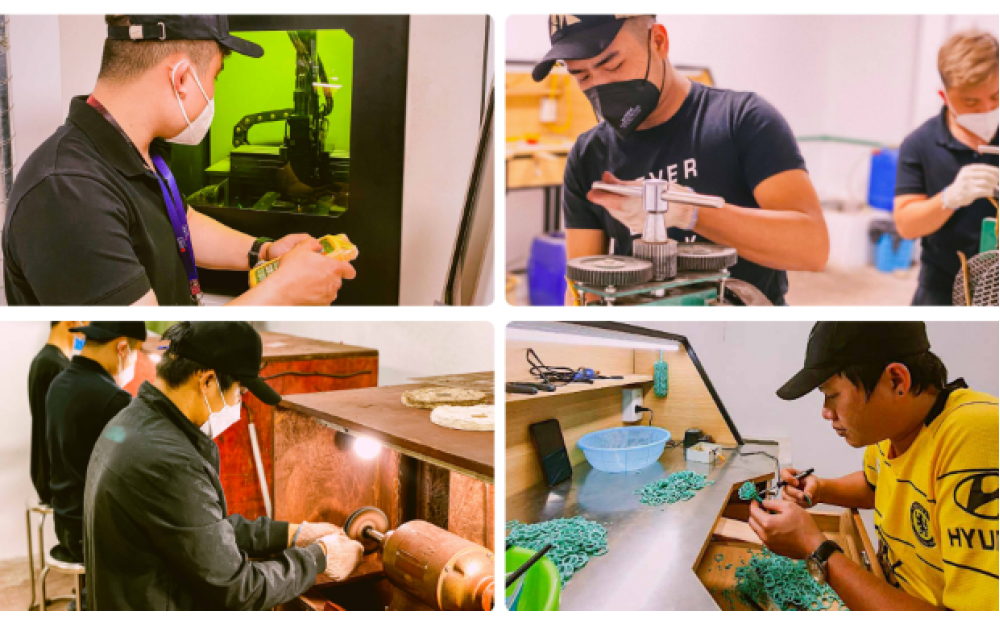
Wax setting is by no means an unfamiliar technique in the jewelry industry. It is widely known for its practical benefits - faster production, lower labor costs, and the ability to handle large volumes with good consistency. In fact, many brands currently regard it as a preferred method instead of hand setting whenever efficiency and competitive pricing are top priorities. But is it actually always the best? The answer is more complicated than most suppliers will admit. There is still a lot of interesting and little-known information behind this technique - those insights that Shinera, a professional jewelry manufacturer in Vietnam, desires to deeply share with you in this article. What Does Wax Setting Really Involve? In wax setting (also called stone-in-place or cast-in-place), stones are positioned directly into the wax model before casting. The models are then invested, the wax is burned out, and molten silver or brass flows around the stones, locking them in place as the metal solidifies. Why Is Wax Setting So Popular? The reasons most brands and wholesalers favor wax setting are straightforward: * It is significantly faster than traditional hand setting * Labor costs are much lower * Consistency across large batches is excellent * It scales well for orders of several hundred to several thousand pieces These advantages make it particularly attractive for fashion jewelry and high-volume silver or brass collections, where competitive pricing and quick turnaround are critical. But Have You Ever Discovered The Reasons Why Wax Setting Is Easier and Faster? Most people know the benefits. Far fewer understand the real reasons behind them. The core advantage of wax setting comes down to the material itself. Wax is soft. When a stone is placed into a wax model, the wax can be gently shaped or pressed around the stone with very little resistance. The process is relatively quick and does not require extreme force or highly specialized skill for every single stone. Once all the stones are positioned, the entire model goes through casting as one unit - the molten metal simply flows around the stones and locks them in place automatically. Hand-setting works in the opposite way. The metal is already hard when the stones are set. Creating seats, adjusting prongs, or refining the metal around each stone takes more time, more physical effort, and higher skill. When a design contains many stones, the production time multiplies quickly. And in manufacturing, time is money - the longer the process takes, the higher the labor cost becomes. This is the fundamental reason wax setting is faster and cheaper: soft wax allows rapid placement, while hard metal demands slower, more careful work. Of course, this efficiency comes with trade-offs in finish quality and long-term durability - points we will examine next. The Limitations That Rarely Appear in Factory Presentations While wax setting is efficient, several important realities are often left unsaid: * The extreme heat of casting can affect even heat-resistant stones. Slight clouding, reduced brilliance, or surface changes are more common than many suppliers acknowledge. Additionally, natural stones and colorful CZ are especially vulnerable to heat — they can crack or lose their original color intensity. * The metal around the stones after casting is usually less refined. Bright-cutting and clean prong work are limited compared with hand-set pieces. * Repairs and re-tightening become more difficult once the stones are locked in during casting. * Long-term security can be weaker. Over months of wear, prongs may loosen more easily than on carefully hand-set jewelry. How Hand Setting Compares in Practice Hand setting follows the traditional sequence: the metal is cast first, then skilled artisans set each stone individually. This method delivers cleaner seats, stronger and more adjustable security, and greater flexibility with different stone types and sizes. One of its most noticeable advantages is superior brilliance. Before or during the setting process, the setter carefully refines and polishes the metal seats that hold the stone — a technique known as bright-cutting. These polished surfaces act like small mirrors, reflecting extra light back up through the stone and making it appear significantly brighter and more sparkling. Hand setting is also the preferred choice for stones that cannot withstand high temperatures, such as natural gemstones or colored synthetic stones. Because the stones are set after casting, they are never exposed to the extreme heat of the casting process, which eliminates the risk of cracking, clouding, or color fading. However, these quality benefits come at a higher cost. Because the stones are set on already-hardened metal, the process is much slower and more labor-intensive. The hard metal resists adjustment, so creating clean seats, shaping prongs, and securing each stone requires more time, greater effort, and higher skill. For these reasons, hand setting is usually reserved for premium collections, smaller quantities, or pieces where maximum sparkle, durability, and the ability to use heat-sensitive stones are the top priorities. A Practical Decision Framework for Brands and Wholesalers Instead of asking which method is “better,” ask these practical questions: What kind of stone would you prefer to use? Are natural stones or just white CZ stones good enough? What is the brand positioning? Fashion or demi-fine and fine jewelry? What is the order volume? What is your target price? How important is long-term durability and after-sales service? ........ Mastering These Insights Creates Real Business Advantages When you know the real differences between wax setting and hand setting inside out, you gain more than technical knowledge - you strengthen your entire sourcing process and partnership with manufacturers. With this clarity, conversations with suppliers become faster and more precise. You can ask the right technical questions, evaluate samples more accurately, and avoid costly misunderstandings. Decision-making speeds up, back-and-forth is reduced, and you are far more likely to secure products that truly match your customers’ expectations - whether that means competitive pricing for fashion lines or superior finish and durability for demi-fine collections. In the long run, mastering these insights helps you build stronger, more efficient partnerships and make purchasing decisions that protect both your margins and your brand reputation. Need Support Choosing the Right Setting Method? If you are too busy running and managing your brand, or if you are newbies to the jewelry industry, that is completely fine. Beyond being a skilled manufacturer, Shinera also acts as a technical consultant. We can review your designs, identify potential issues related to stone setting, and suggest practical adjustments. At Shinera, we will not simply follow every request of customers. Instead, we always aim for the most efficient solution for your business in the long term. As our goal is not just to fulfill orders, but to be someone who genuinely wants to support your growth, so that together, we can move forward and succeed. | |||||||||