You approved the render. You were excited. Then the sample arrives, you open the box, and a small voice says, “wait… that’s not quite what I saw.”
If that has happened to you, you’re in good company. Almost every brand that makes jewelry goes through it at some point. It doesn’t automatically mean your manufacturer got it wrong, but it doesn’t mean you should shrug and accept it either. Here’s the honest picture, from why it happens to how to avoid it.
1. Why the Sample Looks Different: The Journey from Screen to Metal
Your design exists in three versions:
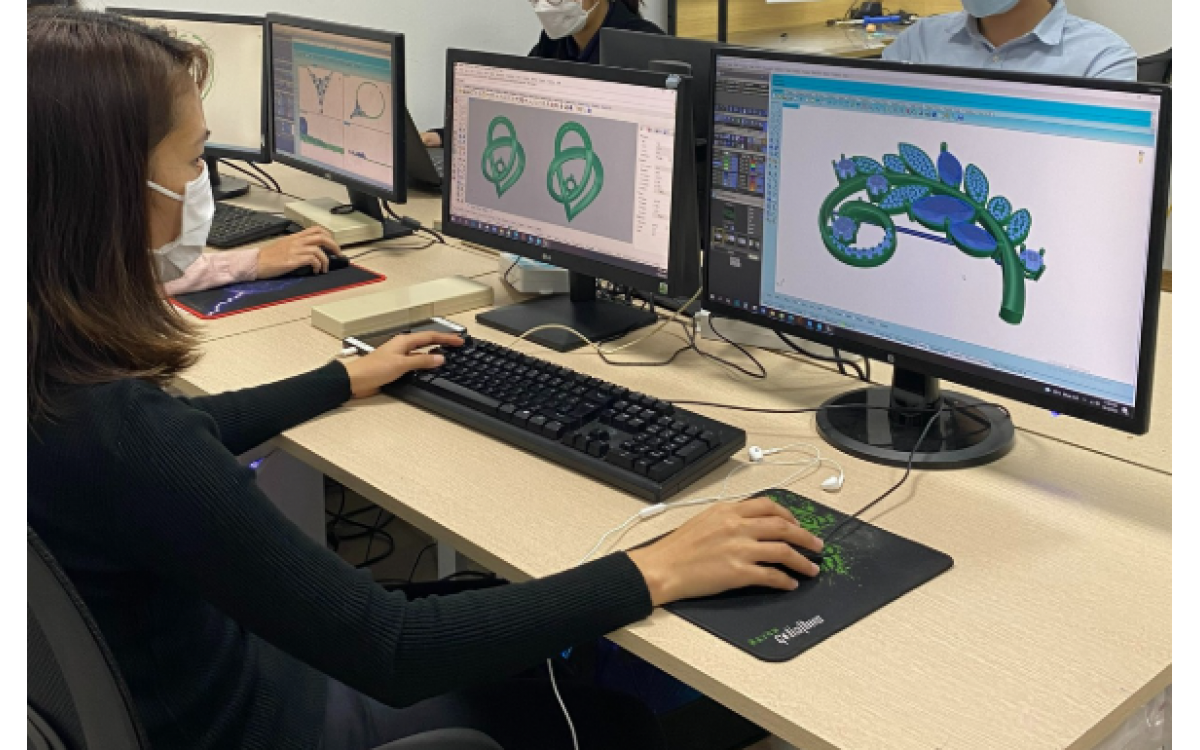
* The render – a perfect digital picture
* The model – the wax or resin version used to make the metal piece.
* The finished piece – real metal after casting, polishing, plating, and hand work.
Each time it moves to the next version, something shifts slightly. These small shifts add up, and that’s how “almost the same” turns into “why does it look different?”
Here is where the changes usually happen:
* Casting: Molten metal contracts as it cools, and not perfectly evenly. Thick and thin areas behave differently, so pieces with very different thicknesses, or several parts that must fit together, are more likely to come out slightly off.
* Polishing: It gives you the shine, but it removes a thin layer of metal, mostly from edges, corners, and high points. Sharp lines soften, and fine textures or shallow details look less defined.
* Plating: Gold or rhodium plating adds a thin layer that slightly fills fine detail and can affect parts that need to fit tightly. Thicker plating usually lasts longer; thinner plating keeps details crisper. (Read more in our article on electroplating in jewelry manufacturing.)
* Hand work: Prongs, stone seats, and final touches are often finished by hand, and a render usually simplifies them. Stones set in wax before casting also leave different metal around them than hand setting does. (Read more: Wax setting vs. hand setting.)
Sometimes, the design itself is the cause. A 3D file can show things that look beautiful when zoomed in on a screen but are very hard to make in metal such as ultra-thin edge, tiny details, very shallow textures or settings with no room for the stone
After casting and polishing, these can get softened or lost. Experienced designers plan for this, sometimes making small details a bit bigger or deeper on screen so they come out right in the real piece. If your file was made by a freelancer who has never worked with a factory, this is a very common reason for disappointment.
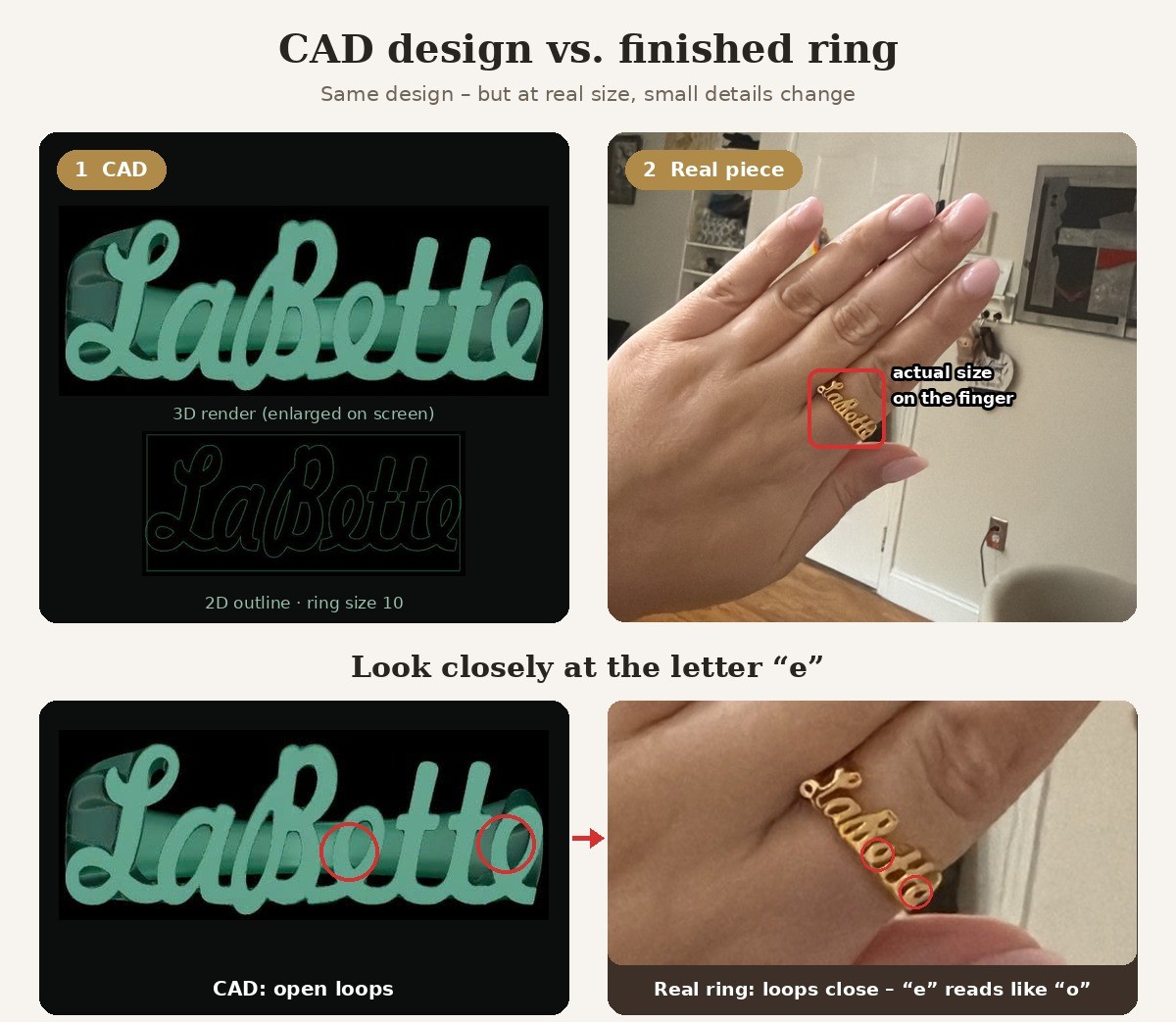
On screen, the loops of the “e” are open. At real size on the finger, they close up and the “e” reads like an “o”.
2. Normal Difference or Real Problem?
Sorting what you see into three groups makes it much less stressful:
| What you notice | Likely cause | What to do |
|---|---|---|
| Slightly softer edges, small color difference between screen and metal, tiny thickness variations | Normal effects of the process | Usually fine. Mention it if it matters to your brand. |
| Tiny details missing, textures too shallow, parts thinner than expected | The design is hard to produce as drawn | Ask for a design adjustment, such as slightly larger or deeper details. |
| Proportions clearly off, parts don’t fit, stones sit badly, weight feels very different | A possible process issue or mismatch with the approved file | Raise it with photos and ask for an explanation and a fix. |
Only the third row is truly worrying. The first two are conversations, not conflicts.
3. How to Avoid Surprises
Most disappointments can be caught early if you build a few habits into the process.
- Have the design reviewed before the sample is made. A conversation with the manufacturer at this stage can spot risky details and save a whole round of revisions.
- Confirm step by step, not just at the end. At Shinera, we usually start by sending you the 3D design to confirm. If you’d like to see more, we’re very happy to share photos or videos of the wax model, or of your piece at any stage, such as surface finishing or plating. Catching something at the wax stage is far easier (and cheaper) than catching it after plating. Just tell us at the start which stages you’d like to see.
- Put the real thing in your manufacturer’s hands. If you already have a physical piece, say a sample from a previous supplier, and you’re switching manufacturers, please send it to us, even if shipping costs a little. Photos can’t show weight, thickness, how the surface catches the light, or how a clasp feels. With the real piece in hand, we can measure, weigh, and compare finishes side by side, and see exactly what “good” means to you. It means much less guesswork and fewer rounds, which usually saves far more than the shipping cost. If it’s your only piece, tell us upfront so we can plan around it.
- Be clear about what matters. Tell us your priorities (size, weight, finish, or one special detail), share a reference photo, and name the version you’re commenting on (“design v2, sample 1”). Once a sample is approved, keep it as your benchmark for the bulk order.
4. How We Work at Shinera
We’re a manufacturer, but we also like to act as a technical partner. Before a sample is made, we can review your design, point out details that might not survive casting and polishing well, and suggest small, practical adjustments.
We won’t simply follow every request. If we think a detail is risky, we’d rather tell you honestly than send you a sample that disappoints. And because design and production happen under one roof, it’s easier for us to trace any difference back to its source and fix it.
Our goal isn’t only to fulfill orders. It’s to support your growth, so that together, we get your pieces right.
Have a design you’re not sure about, or a sample that didn’t turn out as hoped? Send it over and we’ll tell you honestly what we see. No pressure, no strings attached.